What started as an initiative to enhance agricultural productivity and commercialisation through mega farms is facing a bleak future due to inadequate funding, debts owed to suppliers and low loan recoveries.
Malawi Agriculture and Industrial Investment Corporation (Maiic), the co-administrator of the mega farms project, said on Tuesday the initiative owes suppliers K33 billion incurred over the past two years.
Maiic acting chief executive officer Lloyd Banda, in a written response, said since its inception in the 2023/24 season, the mega farms initiative has received K22.2 billion comprising K20 billion during the first year and K2.4 billion in the 2024/25 fiscal year.
Said Banda: “Maiic received financing from government only in the first year of the programme amounting to K20 billion. In the second year [2024/25] the programme was not funded by the government and received nothing from the national budget.
“The only amount that was received in [2024/25 season] was K2.4 billion from a multilateral development partner. The total financing received by the programme from inception is, therefore, K22.4 billion and not the K62 billion [being mentioned].”
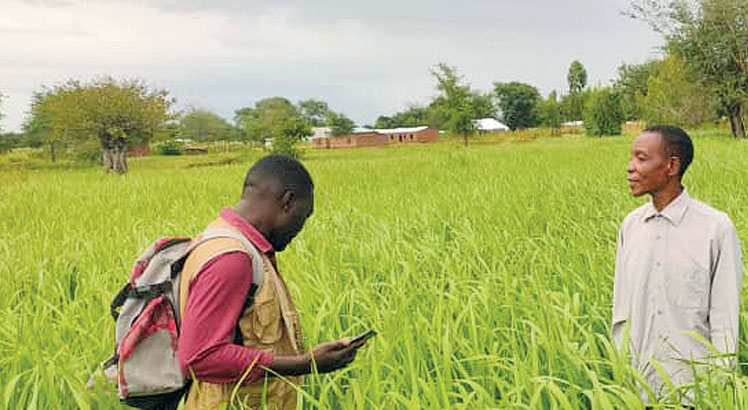
gardens at Khombedza in
Salima. | Nation
He said during the first year, government was expecting to receive additional financing worth K76 billion from development partners, but the money never came.
Banda said Maiic paid K18 billion to mega farms’ suppliers in the current season from the total bill of K48.9 billion, meaning the project is still owing other suppliers K33 billion.
He said most farmers have not delivered their maize to National Food Reserve Agency (NFRA) and Admarc Limited, whose proceeds were meant to pay off loans disbursed under the initiative. He did not give names of those who have not supplied the grain neither did he state how much is yet to be recovered from the issued loans.
Banda said the factors that made farmers not to deliver the maize include perceived low prices that NFRA and Admarc offered as farmers were comparing with how much grain was fetching in 2024 when a 50 kg bag of maize was around K100 000 or K2 000 per kg on the market, especially towards the end of last year.
He said the starting price for the mega farmers was K1 050 per kg (or K52 500 for a 50 kg bag) and this was later adjusted to K1 250 per kg (K62 500 per bag), but farmers are still reluctant to deliver maize at the depots.
Said Banda: “The second challenge encountered is unavailability of funding at both NFRA and Admarc. The challenge is, thus, cases where farmers are planning to make deliveries and they find that there are no funds. In such cases farmers are sent back with their truckloads.
“The problem is that the two institutions cannot receive maize with an expectation that payments will be made in future when funds are received from government.”
From the projected 88 000 metric tonnes (MT) of maize to be delivered to NFRA, Admarc and African Commodities Exchange (ACE) warehouses, only 5 470MT have been delivered, according to Banda.
The revelations of funding gaps come on the back of social media reports claiming that scores of people, including some politically-connected individuals, obtained farm inputs from Maiic under mega farms, but did not pay back.
Recently, agriculture think-tank, Mwapata Institute, suggested reforms in the way mega farms are run so they contribute to the country’s food security.
Mwapata Institute executive director William Chadza said some farmers, for example, contracted under this arrangement received inputs late and never used them.
He suggested that in future, there should be contracts that are binding on both parties.
Meanwhile, Mega Farms Unit director Henry Msatilomo said this week that about K49 billion in form of farm inputs was disbursed to 922 mega farmers contracted under the unit through Maiic financing agreement, but only about K18 billion has been repaid.
He could not specify the total number of farmers that have repaid the loans, but said loan recovery is proving difficult because some borrowers who presented themselves as farmers turned out to be vendors and sold the inputs. He added that such beneficiaries were proving difficult to trace.
Msatilomo said the unit also owes Smallholder Farmers Fertiliser Revolving Fund of Malawi (SFFRM) K21 billion for fertilisers and is indebted to other seed producing companies with varied amounts of money.
Despite the uncertainty surrounding the future of the programme, 4 022 farmers have expressed interest to join mega farming this season, up from about 1 000 in the last farming season, Msatilomo said.
But he said the unit may not finance the programme this season without a government bail out.
Kasungu-based farmer Lucy Changaya said the uncertainty surrounding the future of the programme is haunting them as the rainy season is drawing closer.
“While some mega farmers are genuinely failing to repay loans due to weather shocks, others are yet to pay loans because they have not sold their staple grain,” she said.
Changaya has since called on authorities to find markets for the farmers.
Read the full interview with Maiic
acting CEO on the status of the
initiative on Page 7